Supreme Court Permits Withdrawal of COVID-19 Protest Cases Against Sitting and Former MPs and MLAs in Himachal Pradesh
Introduction
The Supreme Court of India has permitted the withdrawal of prosecution in criminal cases involving sitting and former Members of Parliament (MPs) and Members of Legislative Assemblies (MLAs) in Himachal Pradesh, arising primarily from public demonstrations and protests during the COVID-19 pandemic.
In its order dated 9 September 2026, the Court held that the cases remaining for consideration did not disclose grave or heinous crimes and that continuing the prosecutions would neither advance the administration of criminal justice nor serve the public interest. The Court also took into account the exceptional circumstances prevailing during the pandemic and the nature of the allegations against the public representatives.
The decision is significant because it addresses the exercise of the power to withdraw prosecution against elected representatives while reaffirming the need to consider the nature of the alleged offences and the broader interests of justice. <Link url="https://indiankanoon.org/doc/26711329/" title="Read the Supreme Court order"/>. <Cite refs={["turn790076search0","turn790076search1"]}/>
Background of the Case
The Government of Himachal Pradesh sought permission to withdraw prosecution in 65 criminal cases involving sitting and former MPs and MLAs. These cases arose from incidents during the COVID-19 pandemic, including public dharnas, demonstrations and the raising of public grievances before government authorities.
The cases involved allegations under various provisions of the Indian Penal Code, 1860, the National Highways Act, 1956, and the Disaster Management Act, 2005. The allegations included acts likely to spread infection, alleged use of criminal force against public servants, criminal intimidation and participation in demonstrations during pandemic-related restrictions.
The State's request was considered in light of the Supreme Court's earlier directions requiring judicial scrutiny before prosecution against sitting or former MPs and MLAs could be withdrawn.
By its judgment dated 26 April 2024, the Himachal Pradesh High Court permitted withdrawal in 15 cases but declined the State's request in respect of the remaining cases then under consideration. The State challenged that decision before the Supreme Court.
During the pendency of the proceedings, some additional cases were disposed of. Consequently, the Supreme Court ultimately considered the cases that remained for consideration in the State's application. <Cite refs={["turn790076search0","turn790076search4"]}/>
Legal Issue
The principal issue before the Supreme Court was whether the State should be permitted to withdraw prosecution in the remaining cases, notwithstanding the High Court's refusal to allow withdrawal in those matters.
The issue required the Court to balance the State's request for withdrawal against the need for judicial scrutiny of criminal proceedings involving elected representatives. It also required consideration of whether continuing the prosecutions would serve a legitimate public purpose, having regard to the nature of the allegations and the exceptional circumstances in which the incidents occurred.
Statutory Framework: Withdrawal from Prosecution
Section 321 of the Code of Criminal Procedure, 1973, governed withdrawal from prosecution in the proceedings concerned. It empowers the Public Prosecutor or Assistant Public Prosecutor in charge of a case to withdraw from prosecution, with the consent of the court, at any time before judgment is pronounced.
The provision recognises that prosecution is not required to continue in every case irrespective of the circumstances. However, withdrawal must be considered within the statutory framework and in accordance with established judicial principles. It is not intended to provide an unrestricted power to terminate criminal proceedings for extraneous or purely political considerations.
In the case of sitting and former MPs and MLAs, the Supreme Court had issued additional directions in Ashwini Kumar Upadhyay v. Union of India, requiring prior permission of the jurisdictional High Court for withdrawal of prosecution. This safeguard was intended to ensure judicial scrutiny and prevent misuse of executive power in cases involving elected representatives.
The Himachal Pradesh proceedings arose against this legal background. <Cite refs={["turn790076search0","turn790076search8"]}/>
Supreme Court's Reasoning
The Supreme Court examined the categories of offences alleged in the cases and the circumstances in which they were registered. The Court noted that the incidents arose during the COVID-19 pandemic, an exceptional period marked by uncertainty, restrictions and public distress.
The cases broadly concerned the following allegations:
Acts likely to spread infection of a disease dangerous to life under Section 269 IPC.
Alleged assault or use of criminal force against public servants under Section 353 IPC, without any instance of injury or assault having been caused.
Alleged intentional insult and criminal intimidation under Sections 504 and 506 IPC.
Public dharnas and demonstrations on national highways under the National Highways Act.
Alleged violations under Section 51 of the Disaster Management Act, 2005.
The Court observed that none of the cases remaining for consideration disclosed the commission of a grave or heinous crime. Nor was there any indication that the accused were hardened criminals or had repeatedly engaged in similar offences. The allegations essentially concerned the participation of public representatives in demonstrations and their efforts to raise public grievances.
Taking these circumstances into account, the Court concluded that continuing the prosecutions would not serve the administration of criminal justice or advance the public interest. It also observed that the proceedings would consume valuable judicial time that could otherwise be devoted to serious and contentious matters requiring timely adjudication.
Accordingly, the Supreme Court allowed the State's appeal and permitted withdrawal of prosecution in all the cases remaining for consideration under its application. <Cite refs={["turn790076search0","turn790076search1"]}/>
Significance of the Judgment
1. Withdrawal of prosecution must serve public justice
The decision highlights that withdrawal from prosecution must be examined in light of the nature of the alleged offences, the surrounding circumstances and the public interest involved. The existence of an executive decision to withdraw a case does not, by itself, eliminate the need for judicial scrutiny where such scrutiny is legally required.
2. Exceptional circumstances are relevant
The Court took account of the extraordinary conditions prevailing during the COVID-19 pandemic. The circumstances in which an alleged offence occurred may be relevant when determining whether continuation of prosecution serves a legitimate purpose.
However, the judgment should not be understood as establishing a general exemption from criminal liability for offences committed during the pandemic. The Court's reasoning was based on the particular allegations and circumstances of the cases before it.
3. Judicial time is a relevant consideration
The Supreme Court also considered the impact of continuing these proceedings on the administration of justice. Where prosecutions do not serve a meaningful public purpose, their continuation may divert judicial resources from more serious cases requiring expeditious adjudication.
This consideration formed part of the Court's reasoning for allowing the State's request.
4. Judicial scrutiny in cases involving elected representatives remains important
The decision must be read alongside the Supreme Court's earlier directions requiring High Court permission for withdrawal of prosecutions involving sitting and former MPs and MLAs.
The ruling does not remove that safeguard. Rather, it demonstrates that a court must assess the particular facts, allegations and public interest considerations when deciding whether withdrawal should be permitted.
Conclusion
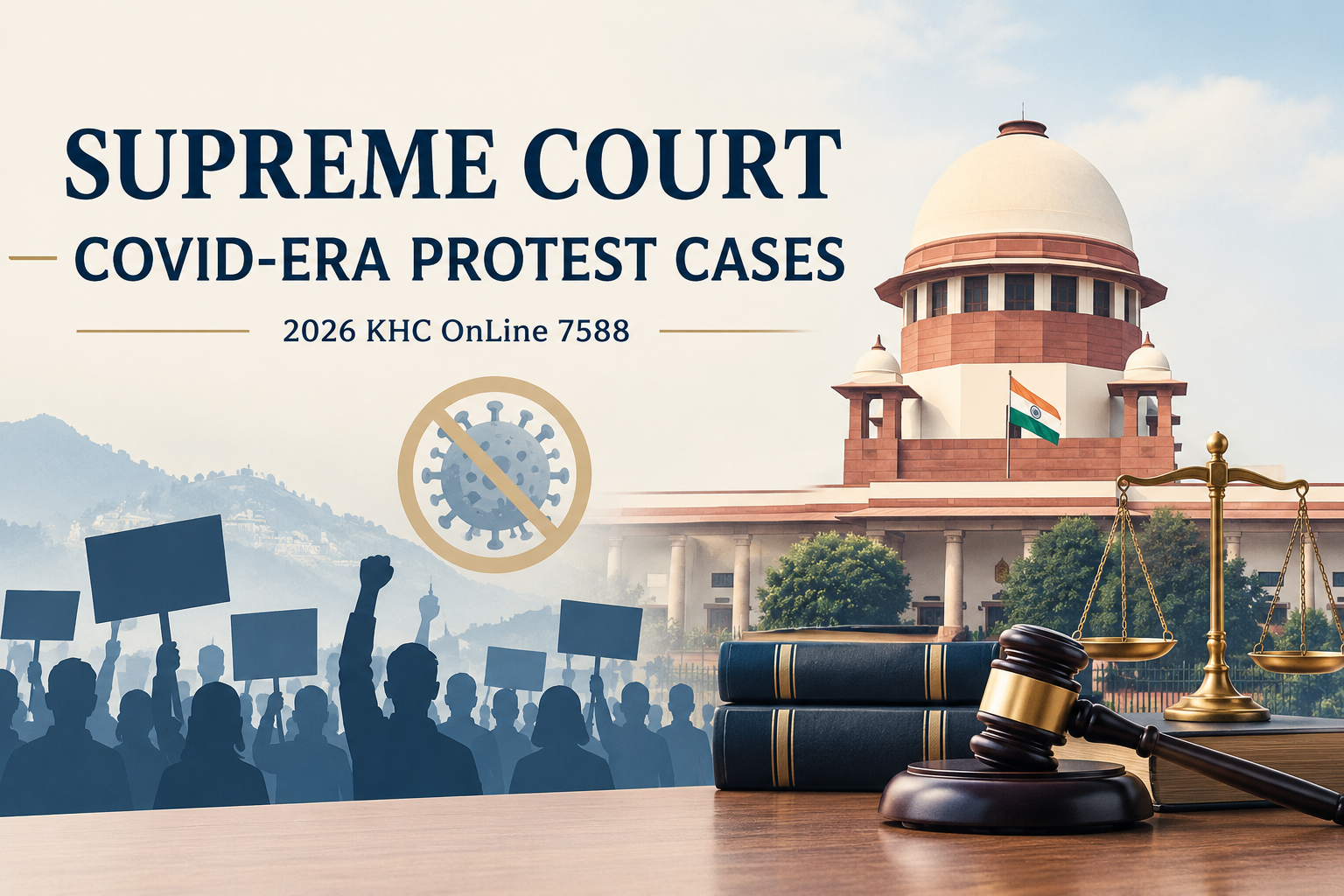
The decision in State of Himachal Pradesh v. Court on Its Own Motion, reported as 2026 KHC OnLine 7588, is an important ruling on withdrawal from prosecution in cases involving elected representatives.
By permitting withdrawal in the remaining COVID-19-era cases, the Supreme Court emphasised the significance of the nature of the alleged offences, the exceptional circumstances in which they arose and the practical consequences of continuing the proceedings.
The judgment illustrates that criminal prosecution should serve the ends of justice and the public interest rather than continue mechanically without regard to the circumstances of the case. At the same time, the requirement of judicial scrutiny in cases involving elected representatives remains a critical safeguard against arbitrary or politically motivated withdrawal.
Need legal assistance regarding a similar matter?
Submit an enquiry to discuss your legal matter.
Send an Enquiry