RTI Act and Certified Copies from Sub-Registrar Offices
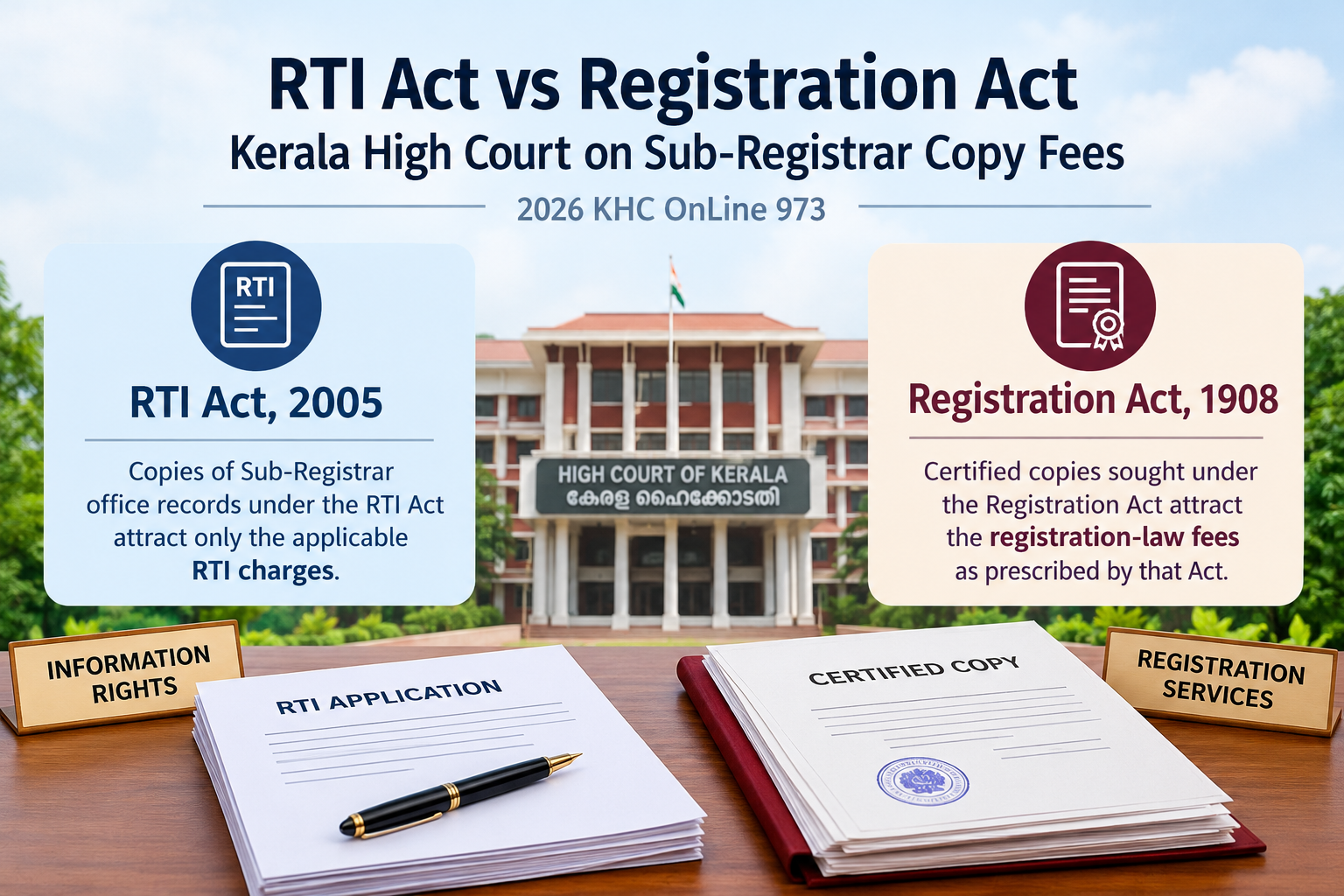
RTI Act vs Registration Act: Kerala High Court Clarifies the Fees Payable for Copies of Sub-Registrar Office Records
Case reference: 2026 KHC OnLine 973
Introduction
The Right to Information Act, 2005, is a vital instrument for ensuring transparency and accountability in public administration. It enables citizens to access government records, examine official decisions and obtain information held by public authorities. However, disputes can arise when a public authority demands fees under a separate statute even though the applicant has sought information under the RTI Act.
The decision reported as 2026 KHC OnLine 973 addresses an important question concerning access to records maintained by Sub-Registrar offices in Kerala: whether an applicant seeking copies of such records under the RTI Act must pay the fees prescribed under the Registration Act, 1908, or only the fees applicable to an RTI request.
The legal proposition highlighted by the decision distinguishes between obtaining copies under the RTI framework and applying for certified copies under the registration-law framework.
The Legal Issue
Sub-Registrar offices maintain various public records relating to registered documents and registration proceedings. Citizens may require access to these records for property transactions, civil litigation, title verification and other legal purposes.
The Registration Act, 1908, provides a statutory framework for registration-related services, including the issuance of copies of documents and entries in registration records. Section 78 of the Act deals with the power to prescribe fees payable in connection with registration-related functions.
A separate statutory mechanism exists under the RTI Act, 2005, through which citizens can request information held by public authorities.
The central issue is whether the fee structure applicable to obtaining certified copies under the Registration Act can automatically be imposed on an applicant who seeks copies of records through an RTI application.
The Distinction Between the Two Statutory Procedures
1. Obtaining information under the RTI Act
Section 2(f) of the RTI Act defines the expression “information” broadly to include records, documents and other material held by or under the control of a public authority. Section 2(j) recognises the right to obtain information through various means, including inspection of records and taking certified copies or extracts of documents.
Section 7(1) provides the general framework for responding to requests, while Section 7(3) deals with communication of additional fees where applicable.
Consequently, an application made under the RTI Act must ordinarily be dealt with under that Act and the applicable RTI rules governing fees and access to information.
The Kerala Government's official RTI portal also provides for online filing of applications and payment of the prescribed RTI fees. Kerala RTI Portal.
2. Obtaining certified copies under the Registration Act
The Registration Act, 1908, separately governs the registration of documents and related services. Section 57 deals with inspection of certain registration books and indexes and the grant of copies of entries in the circumstances specified by the provision. Section 78 authorises the prescription of fees for registration-related services.
The Kerala Registration Department publishes a fee schedule under Section 78, including charges relating to copies of specified documents and registration records.
An applicant who chooses to obtain a certified copy through the procedure prescribed under the Registration Act must comply with the applicable statutory requirements and fee schedule.
The two procedures therefore serve related but distinct purposes. The existence of a prescribed fee for a service under registration law does not, by itself, resolve the question of what fee is payable when information is sought through a separate statutory mechanism.
The Principle Highlighted by the Decision
The proposition associated with 2026 KHC OnLine 973 is that a person seeking copies of Sub-Registrar office records under the RTI Act is required to pay the applicable RTI charges, whereas the fees prescribed under the Registration Act apply when certified copies are sought under that Act.
This distinction is significant because it recognises the importance of identifying the statutory basis of the request before determining the applicable fee.
The legal analysis must focus on the nature of the application, the relief sought and the statutory procedure invoked. A request for information under the RTI Act should not automatically be treated as an application for a registration-department service merely because the information is maintained in a Sub-Registrar office.
At the same time, the precise scope of the judgment must be understood from its full text. The distinction should not be interpreted as eliminating every fee associated with obtaining copies of registration records in all circumstances.
Implications for Property Owners and Litigants
The principle is particularly relevant to individuals involved in property disputes and civil litigation.
A person may require information concerning a registered deed, the entries in registration records or the administrative proceedings of a Sub-Registrar office. Such information may assist in verifying a transaction, preparing pleadings or examining the circumstances surrounding a disputed registration.
Where the request is made under the RTI Act, the applicant can rely on the distinction between the RTI procedure and the statutory procedure for obtaining certified copies when questioning the legal basis of a fee demand.
For advocates, the decision highlights the importance of clearly identifying the relief sought in an application. If the immediate objective is to obtain information for inspection or legal research, an RTI application may be appropriate. If the objective is to obtain a certified copy for use in court or another formal proceeding, the requirements of the relevant statutory procedure must be examined carefully.
Whether an RTI-supplied copy will be sufficient for a particular evidentiary purpose is a separate question and should not be confused with the issue of fees.
Conclusion
The decision reported as 2026 KHC OnLine 973 highlights an important distinction between the Right to Information Act, 2005, and the Registration Act, 1908, in relation to obtaining copies of records maintained by Sub-Registrar offices.
The broader legal significance lies in the principle that the applicable fee must be determined with reference to the statutory procedure under which the request is made. The fee schedule governing certified copies under registration law and the fee regime governing RTI applications should not be treated as interchangeable without examining the relevant legal provisions.
The decision is therefore relevant to citizens seeking access to public records, property owners involved in disputes and advocates advising clients on access to registration-related information.
Editorial note: This article is based on the stated legal proposition associated with 2026 KHC OnLine 973. The full judgment text, including the precise directions and any qualifications imposed by the Court, should be verified before quoting the decision in pleadings or formal legal opinions.
Need legal assistance regarding a similar matter?
Submit an enquiry to discuss your legal matter.
Send an Enquiry