Supreme Court Clarifies Compensation Regime for Land Acquisitions under the National Highways Act: A Significant Relief for Landowners
Introduction
In a significant judgment affecting thousands of landowners across India, the Supreme Court has clarified the entitlement to solatium, interest, and interest on solatium in land acquisition proceedings under the National Highways Act, 1956. The Court has reaffirmed that landowners whose lands were acquired for national highway projects cannot be denied these statutory benefits merely because the acquisition proceedings commenced before 1 January 2015. However, the Court has also laid down a crucial distinction regarding the law applicable for calculating such benefits.
This ruling resolves longstanding uncertainty concerning whether compensation should be determined under the Land Acquisition Act, 1894 or under the Right to Fair Compensation and Transparency in Land Acquisition, Rehabilitation and Resettlement Act, 2013.
The Legal Issue
Following the enactment of the 2013 Act, disputes arose regarding the compensation payable in acquisitions carried out under the National Highways Act. Landowners contended that they were entitled to enhanced benefits including solatium and interest, while acquiring authorities often resisted such claims, particularly in cases where acquisition proceedings had commenced before the new compensation regime came into force.
The central question before the Supreme Court was:
Which law governs the computation of solatium and interest when land is acquired under the National Highways Act and the proceedings straddle the transition between the 1894 Act and the 2013 Act?
Supreme Court's Findings
The Supreme Court held that landowners whose lands were acquired under the National Highways Act are entitled to receive solatium, interest, and interest on solatium as part of just compensation. These benefits cannot be denied solely because the acquisition proceedings relate to a period prior to 1 January 2015.
More importantly, the Court clarified that:
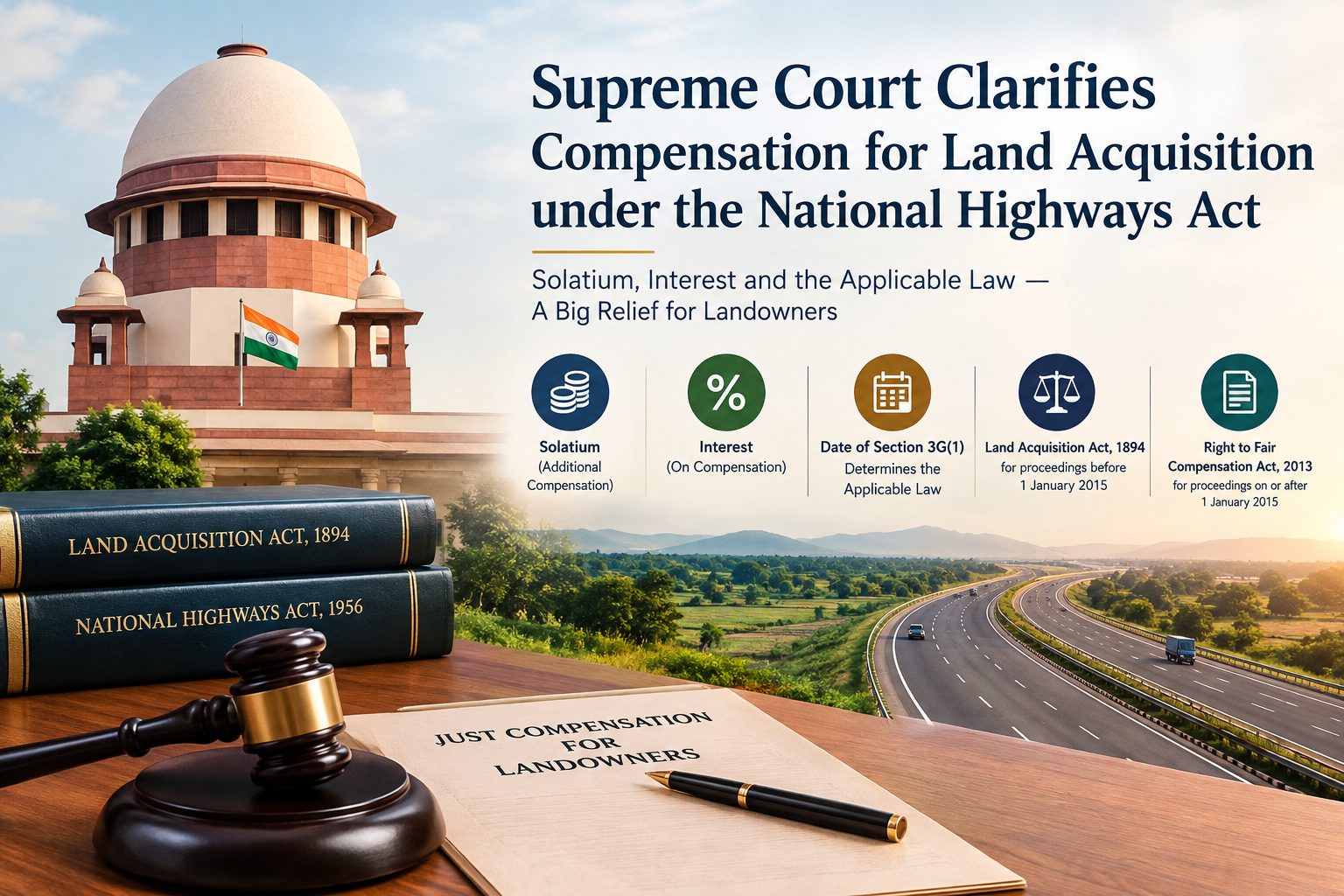
The relevant date is the date on which the Competent Authority determines compensation under Section 3G(1) of the National Highways Act.
If such determination was made before 1 January 2015, compensation benefits including solatium and interest must be calculated under the Land Acquisition Act, 1894.
If the determination was made on or after 1 January 2015, the more beneficial provisions of the 2013 Act would apply.
A subsequent arbitral award under Section 3G(5) does not alter the applicable compensation regime.
Constitutional Perspective
The judgment reinforces the constitutional principle that acquisition of private property must be accompanied by fair and just compensation. The Court emphasized that financial implications for the acquiring authority cannot be a valid reason to deny statutory compensation benefits to affected landowners.
By doing so, the Court has strengthened the protection available to citizens whose properties are compulsorily acquired for public purposes.
Practical Impact of the Judgment
This decision is likely to have substantial implications for pending land acquisition disputes across the country:
Landowners involved in ongoing National Highways Act compensation proceedings may now seek computation of solatium and interest in accordance with the principles laid down by the Supreme Court.
Competent Authorities and Arbitrators will be required to examine the date of the original Section 3G(1) determination before applying the compensation regime.
The judgment provides greater certainty and uniformity in the adjudication of National Highways Act compensation claims.
While the Court protected the rights of landowners, it also clarified that fully concluded and long-settled cases cannot ordinarily be reopened merely for claiming additional benefits.
Conclusion
The Supreme Court's ruling marks an important development in Indian land acquisition jurisprudence. By clarifying the applicable compensation regime and reaffirming the entitlement to solatium and interest, the Court has struck a balance between the rights of landowners and the need for legal certainty in public infrastructure projects.
For lawyers, landowners, and acquiring authorities alike, this judgment serves as an authoritative guide on compensation disputes arising under the National Highways Act and is likely to influence a large number of pending and future claims throughout the country.
Author: Adv. Vishnudhathan P.R.
Advocate, Kerala High Court & Trial Courts
Need legal assistance regarding a similar matter?
Submit an enquiry to discuss your legal matter.
Send an Enquiry