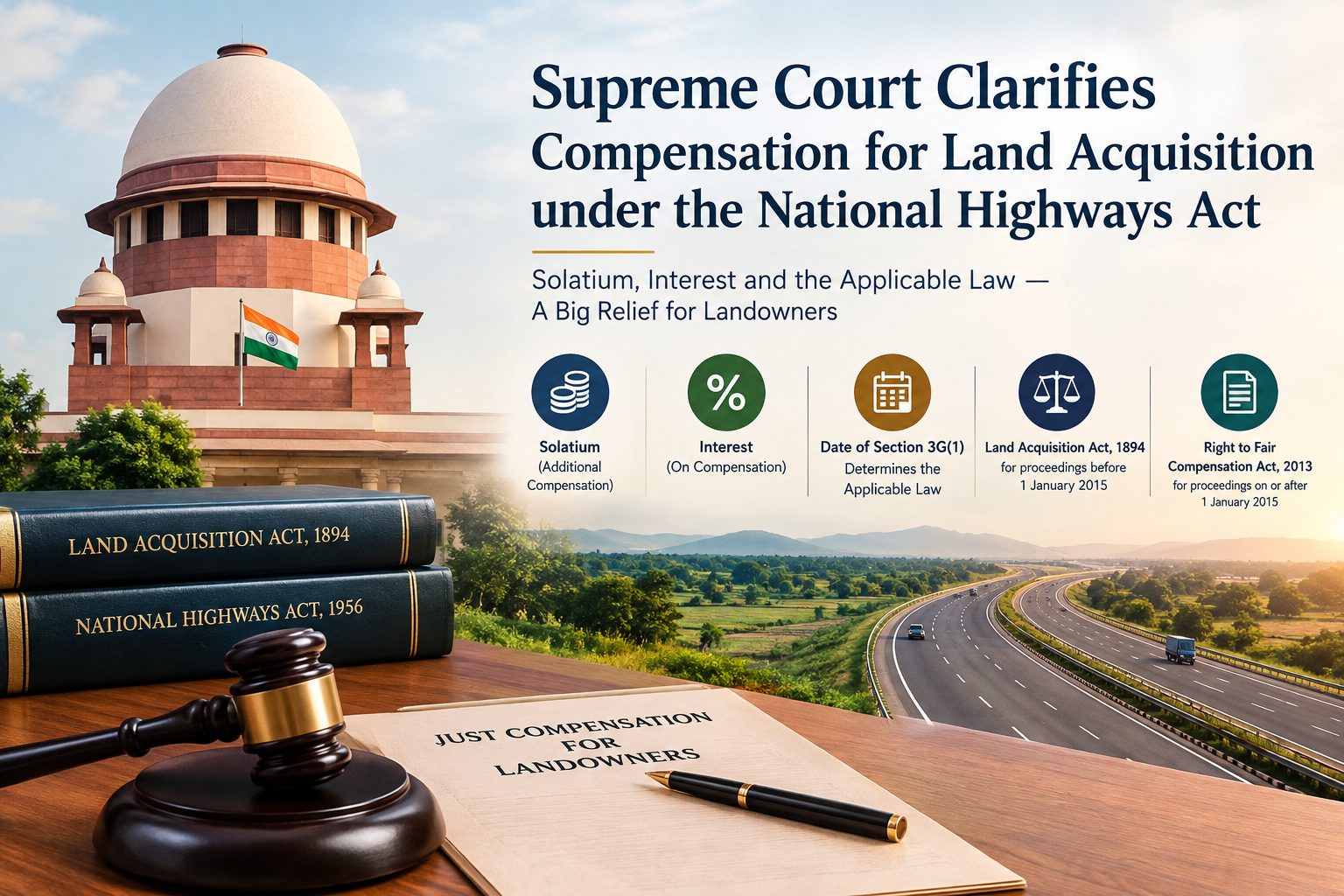
Land Classification, Possession and Reassessment of Basic Land Tax
Possession Before Reassessment: A Procedural Lesson in Land Classification
2026 KHC OnLine 6385 — Leela M. & Others v. Revenue Divisional Officer
Land classification and reassessment of basic land tax are matters that frequently reach the constitutional courts in Kerala, particularly where the revenue records do not correspond with the present nature or use of the property. The decision in Leela M., Satheesh Kumar, Anoop Kumar, Sudheeshma P. & Sanjay Krishna M. v. Revenue Divisional Officer, 2026 KHC OnLine 6385, decided by Justice P.V. Kunhikrishnan, highlights an important procedural aspect: the question of possession cannot be overlooked while considering an application concerning land classification and reassessment.
The dispute
The petitioners approached the Kerala High Court seeking directions concerning their property in Re-Survey No. 133/1 (133/27 as per the Town Planning records) of Cheruvannur Village, Kozhikode Taluk.
Among other reliefs, they sought a direction to the Revenue Divisional Officer to attain finality on Ext.P10 and to recognise the property as dry land. They also sought consequential directions to change the nature of the property in the Basic Tax Register (BTR) and to reassess the basic land tax under the Kerala Land Tax Act, 1961.
Thus, the proceedings were not merely about the description of land in a revenue record. The relief sought had a direct connection with the consequential reassessment of the property for revenue purposes.
The significance of possession
When the matter came before the High Court, the Government Pleader drew the Court's attention to the particulars regarding possession contained in the writ petition. The Court therefore considered that the question of possession had a bearing on the manner in which the application could be processed.
This is significant from a procedural perspective. A request for alteration of land classification and reassessment cannot necessarily be considered in isolation from the factual circumstances surrounding the property. Revenue authorities must have sufficient clarity regarding the person claiming the relevant rights and possession before proceeding with consequential changes in revenue records.
The decision therefore illustrates the distinction between a claim relating to the character of land and the procedural requirements that must be satisfied before the revenue authorities can act upon that claim.
Revenue records and substantive rights
An important practical point emerging from the decision is that a revenue entry should not be viewed as an independent adjudication of title or possession.
The Basic Tax Register is fundamentally a revenue record. A request to modify its entries may require the authority to examine the factual and statutory circumstances relevant to the proposed alteration. Where possession itself is unclear or disputed, the authority may not be in a position to mechanically proceed with reassessment.
This becomes particularly relevant in Kerala, where landowners frequently seek changes in revenue records following changes in the physical nature or use of land.
The role of judicial review
The case also demonstrates the limits of the writ jurisdiction when the underlying factual position requires clarification.
A writ of mandamus is intended to compel a public authority to perform a legal duty. It does not ordinarily permit the High Court to bypass factual questions which the competent statutory authority is required to consider in the first instance.
Therefore, where an application for change of land classification or reassessment raises questions concerning possession, the appropriate course may involve clarification and consideration of those factual aspects by the competent authority rather than an immediate direction to make the requested revenue alteration.
Practical takeaway
For practitioners dealing with land-classification and BTR disputes, the decision serves as a useful reminder to examine the possession aspect at the very beginning of the proceedings.
Before seeking a writ directing alteration of the BTR or reassessment of basic tax, the following should be clearly established:
- the identity and extent of the property;
- the relevant survey and re-survey numbers;
- the present classification of the property;
- the documentary basis for claiming a change in classification;
- the applicant's possession and supporting documents;
- the status of any competing claim over possession; and
- the statutory application already submitted before the revenue authority.
The decision does not make possession the sole determinant of land classification. Rather, it demonstrates that procedural clarity concerning possession may be essential before the revenue machinery can effectively act upon a request for consequential changes in the revenue records.
Conclusion
Leela M. v. Revenue Divisional Officer is a useful reminder that land-revenue disputes are often as much about procedure and factual foundation as they are about the classification of land itself.
For a landowner seeking correction of the nature of property and reassessment of basic tax, establishing the factual foundation—including possession—can be crucial. The judgment therefore provides a practical lesson for both litigants and practitioners: before asking the Court to direct a revenue authority to alter its records, ensure that the foundational facts necessary for such alteration are clearly established.
Need legal assistance regarding a similar matter?
Submit an enquiry to discuss your legal matter.
Send an Enquiry