Kerala High Court Dismisses ₹15,000 Monthly Maintenance Plea by 83-Year-Old Woman: A Legal Perspective
Introduction
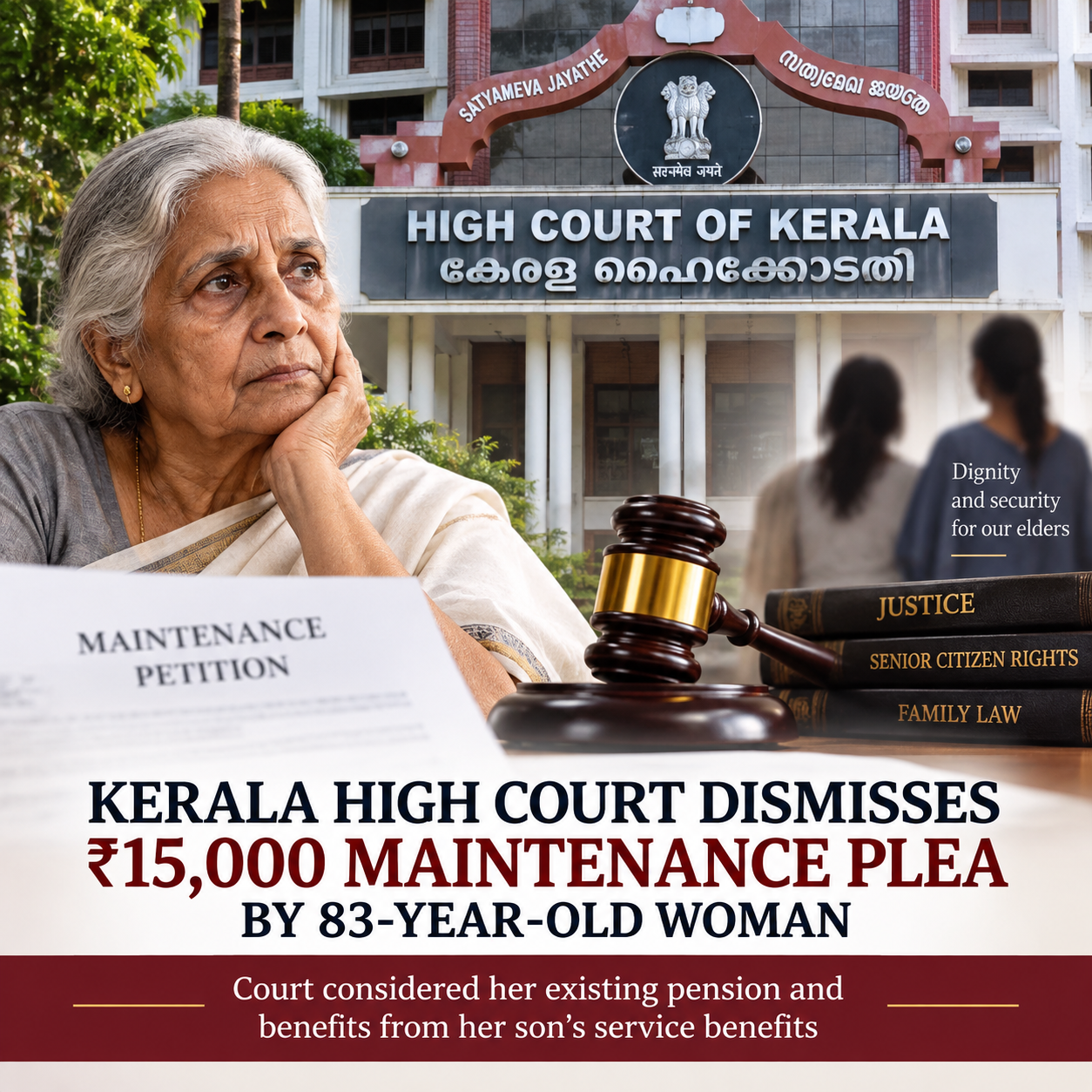
The Kerala High Court recently considered an important issue concerning the maintenance rights of senior citizens and the financial responsibilities of family members. The case involved an 83-year-old woman who sought monthly maintenance of ₹15,000 from her deceased son's wife and daughter.
While the financial needs and welfare of elderly parents are matters of significant social and legal concern, the Court examined the complete financial circumstances of the petitioner before deciding whether a further maintenance order was justified.
Background of the Case
The petitioner, an 83-year-old woman, approached the court seeking financial assistance of ₹15,000 per month from her deceased son's wife and daughter.
Her claim was based on the need for financial support during her advanced age. The dispute therefore raised an important question: Can a senior citizen seek maintenance from relatives when she is already receiving pension and other financial benefits?
The Court examined the petitioner's existing sources of income and the financial benefits available to her following the death of her son.
What Did the Kerala High Court Consider?
The Court did not consider the petition merely on the basis of the petitioner's age. Instead, it examined her overall financial position.
One of the significant considerations was that the petitioner was already receiving a pension. The Court also took into account the benefits that she had received from her son's service-related benefits.
Therefore, the Court found that the circumstances did not justify directing the daughter-in-law and granddaughter to pay an additional ₹15,000 every month.
Legal Principle
The case highlights an important principle in maintenance proceedings: the existence of a legal right to seek maintenance does not automatically mean that a particular amount must be awarded.
Courts generally consider factors such as:
The age and condition of the claimant
The claimant's existing income and financial resources
The actual financial needs of the claimant
The income and financial capacity of the person from whom maintenance is sought
Benefits, pension or other financial resources already available
The overall circumstances of the family
Thus, a maintenance claim is normally determined after considering the financial circumstances of both sides.
Senior Citizens and Maintenance Rights
Indian law provides protection to senior citizens who are unable to maintain themselves. The Maintenance and Welfare of Parents and Senior Citizens Act, 2007 provides a statutory framework for parents and senior citizens to seek maintenance from children and certain relatives in appropriate circumstances.
However, maintenance proceedings require consideration of the facts of each individual case.
The objective of the law is not simply to impose a financial burden on relatives. It is intended to ensure that elderly persons are able to live with dignity and receive appropriate financial support when they genuinely require it.
Does This Judgment Mean Senior Citizens Cannot Claim Maintenance?
No.
The dismissal of one maintenance petition does not mean that senior citizens have no right to claim maintenance.
Each case depends upon its own facts. If an elderly person has insufficient income to meet basic needs, the court or appropriate authority may examine the claim in accordance with the applicable law.
The important point arising from this case is that the court may examine whether the claimant already has adequate financial resources, including pension and other benefits, before ordering additional maintenance.
Importance of the Decision
This decision is significant because it demonstrates the importance of a balanced approach in family maintenance disputes.
The law seeks to protect senior citizens, but maintenance orders are not necessarily determined solely by age or relationship. The financial position, available resources and actual requirements of the claimant can play an important role.
At the same time, family members should remember that elderly parents and senior citizens are entitled to legal protection where they genuinely lack sufficient means for their maintenance.
Conclusion
The Kerala High Court's decision highlights the need to examine the complete financial circumstances of a senior citizen before granting a maintenance claim.
For senior citizens, the case serves as a reminder that legal remedies are available when they are unable to maintain themselves. For relatives facing maintenance proceedings, it demonstrates the importance of presenting complete and accurate financial information before the court.
Ultimately, maintenance law attempts to strike a balance between protecting vulnerable elderly persons and ensuring that maintenance orders are based on genuine financial need and the circumstances of the parties.
This article is intended for general legal awareness and should not be treated as legal advice. The outcome of every maintenance case depends on its specific facts, evidence and applicable law.
Need legal assistance regarding a similar matter?
Submit an enquiry to discuss your legal matter.
Send an Enquiry