Hindu wills and proof/revocation of wills.
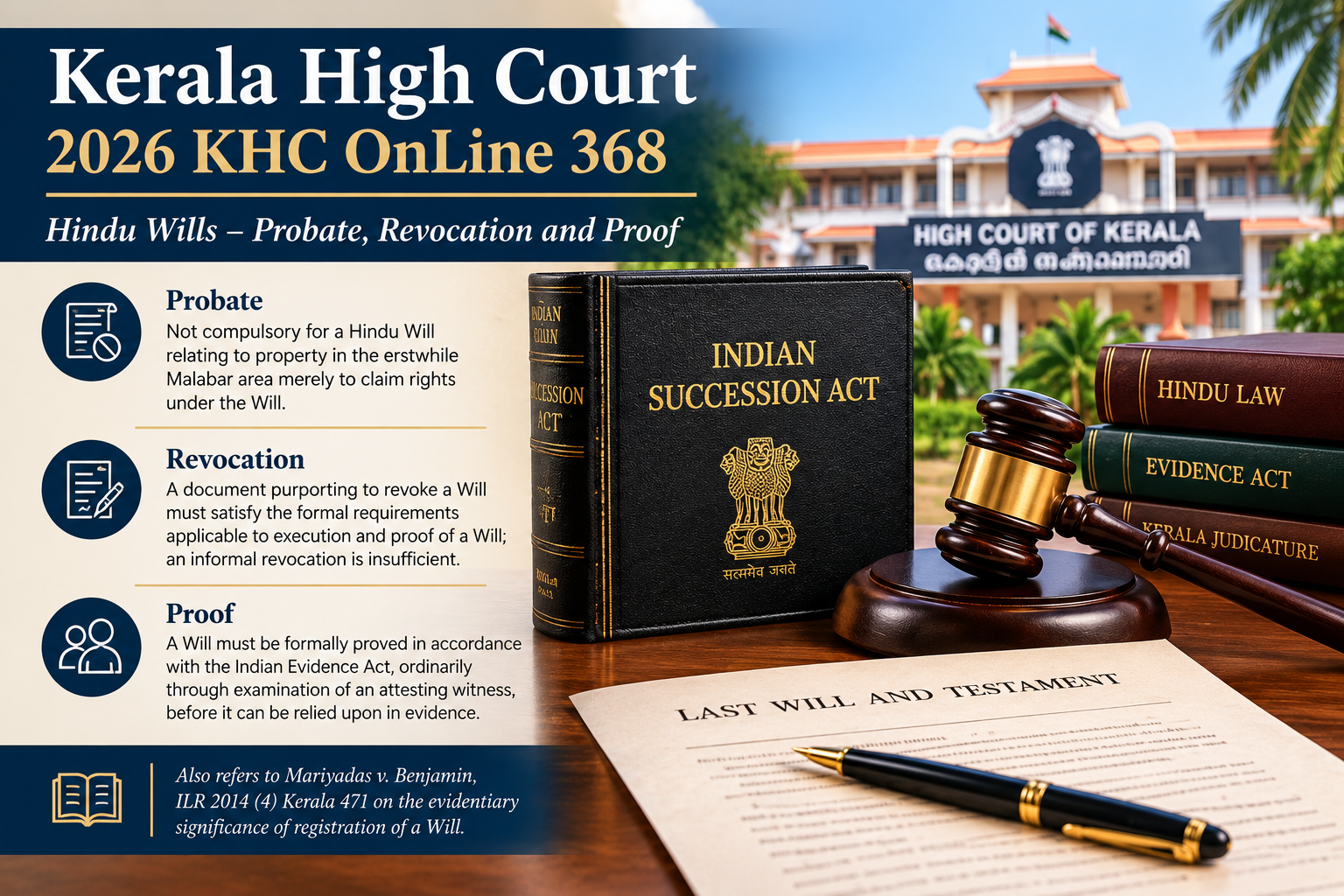
The most important practical aspect is that the judgment does not equate registration of a Will with proof of the Will. Registration may be a circumstance supporting genuineness, but the testamentary document still has to be proved in accordance with the law governing Wills. The judgment's emphasis on examination of an attesting witness is therefore particularly important in a contested succession suit.
The decision also draws an important distinction between the validity of a Will and the requirement of probate. For property in the erstwhile Malabar area, a Hindu beneficiary does not have to obtain probate merely because the instrument is a Will. That should not, however, be misunderstood to mean that the Will automatically establishes title: its due execution and testamentary capacity, and compliance with the requirements of Section 63 of the Indian Succession Act read with Section 68 of the Evidence Act, remain matters of proof where disputed.
The proposition concerning revocation is equally significant. A testator cannot ordinarily neutralise an earlier Will merely through an informal writing or declaration. Where revocation is by a subsequent testamentary instrument or another permitted mode, the statutory requirements governing revocation have to be satisfied. This prevents uncertainty arising from alleged oral or casually documented revocations.
Need legal assistance regarding a similar matter?
Submit an enquiry to discuss your legal matter.
Send an Enquiry